Industry Context / Market Opportunity
The United Arab Emirates has become one of the fastest-growing education hubs in the Middle East. With world-class universities, private training institutes, and professional education centers, the UAE education sector is rapidly evolving to meet the demands of a modern digital economy.
Government initiatives such as UAE Vision 2031 emphasize innovation, digital infrastructure, and smart learning environments across educational institutions. As a result, universities and institutes in Dubai, Abu Dhabi, and Sharjah are increasingly investing in technologies that improve academic management and student engagement.
Despite this progress, many institutes still rely on traditional administrative processes that were designed for smaller classrooms and simpler academic structures.
One such process that continues to create operational inefficiencies is manual attendance management.
While attendance tracking may seem like a routine academic task, the reality is that manual attendance systems consume significant time and often lead to data inaccuracies.
As institutes grow in size and complexity, managing attendance through spreadsheets or manual records becomes increasingly difficult.
Problem Explanation
Manual attendance management is still widely practiced in many institutes across the UAE. Faculty members often mark attendance using paper registers, spreadsheets, or basic digital tools that require manual updates.
Although these methods have been used for years, they present several operational challenges.
First, manual attendance tracking consumes valuable teaching time during every lecture. Even a few minutes spent marking attendance in each class can accumulate into hours of lost productivity every week.
Second, manual records increase the risk of errors. Missing entries, incorrect updates, and inconsistent records often create confusion when administrators generate attendance reports.
Third, institutes struggle to monitor attendance trends in real time. Without a centralized system, identifying students with low attendance or irregular participation becomes difficult.
Another challenge appears when administrators are required to prepare academic reports for management or regulatory bodies. Gathering attendance data from multiple spreadsheets or registers becomes a time-consuming process.
As student numbers grow and academic programs expand, manual attendance systems simply cannot scale effectively.
AzzipTech Positioning
To help institutes overcome administrative inefficiencies, AzzipTech has developed a modern Learning Management System designed specifically for educational institutions.
The platform centralizes multiple academic processes, allowing institutes to manage courses, attendance, communication, and assessments from a single system.
AzzipTech’s LMS is designed to simplify academic operations while reducing the administrative workload on faculty and management teams.
By integrating intelligent automation into everyday academic workflows, institutes can improve operational efficiency and maintain accurate academic records without relying on manual processes.
The platform is flexible enough to support universities, colleges, and professional training institutes operating in fast-growing education markets such as the UAE.
Solution Methodology
Modern institutes are now adopting centralized LMS platforms to automate attendance tracking and streamline academic management.
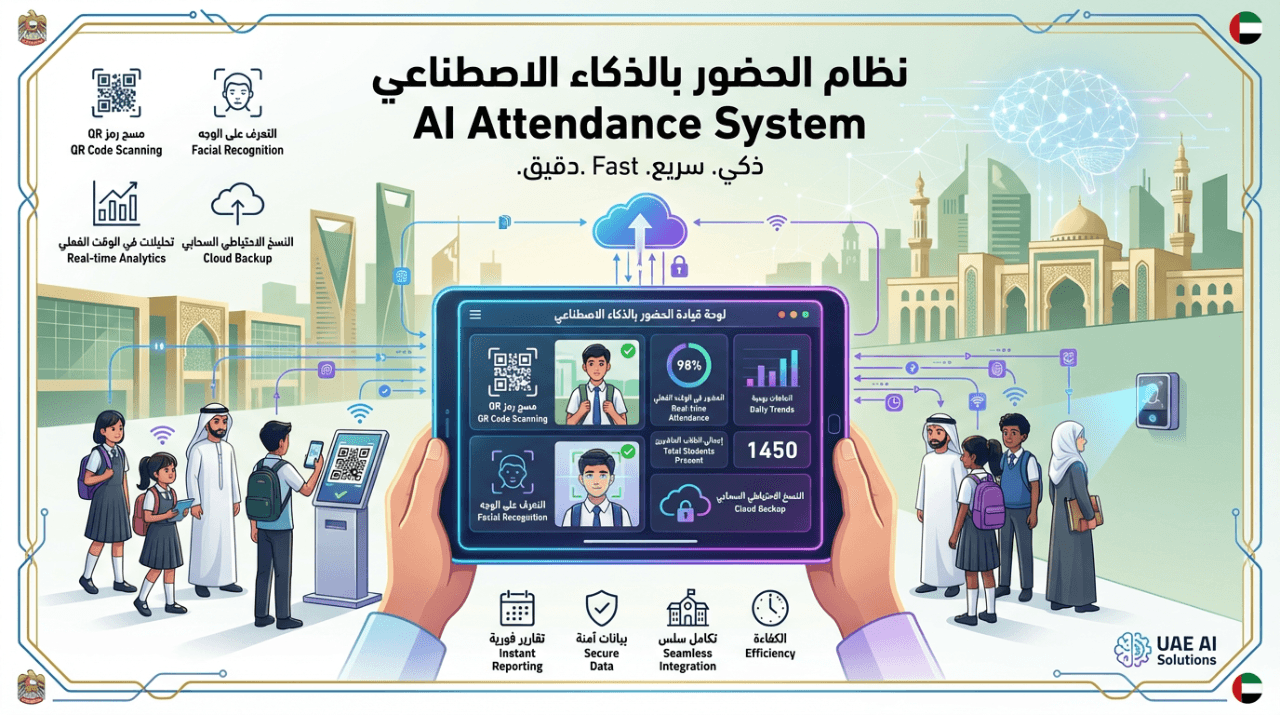
AzzipTech’s LMS introduces AI-powered attendance tracking, which allows attendance to be recorded automatically during live sessions.
Instead of spending time manually marking attendance, the system uses intelligent technologies such as face detection to identify students and record attendance in real time.
This automation ensures that attendance records are accurate, transparent, and tamper-proof.
In addition, administrators can access attendance data instantly through a centralized dashboard. This makes it easier to monitor attendance patterns across courses, batches, and academic programs.
Faculty members also benefit from reduced administrative tasks, allowing them to focus more on teaching and mentoring students.

Benefits
Automating attendance management through an LMS provides several benefits for institutes in the UAE.
One of the most significant advantages is the reduction of administrative workload. Faculty members no longer need to manually record and maintain attendance registers for every class.
Another important benefit is improved data accuracy. Automated systems eliminate the risk of manual entry errors and ensure that attendance records remain consistent.
Institutes also gain real-time visibility into student participation. Administrators can easily identify students with low attendance and take timely action to support them.
In addition, automated systems allow institutes to generate reports instantly, which simplifies internal academic reviews and compliance requirements.
By digitizing attendance management, institutes create a more efficient and transparent academic environment.
Case Example
Educational institutions that have implemented centralized LMS platforms have reported significant improvements in academic operations.
For example, institutes that previously relied on spreadsheets and manual registers often experienced delays in generating attendance reports and identifying irregular students.
After implementing automated attendance systems, these institutions were able to streamline academic management processes and reduce administrative workload.
Faculty members spent less time on repetitive administrative tasks, while administrators gained better visibility into student engagement.
As a result, institutes were able to improve operational efficiency and focus more on delivering quality education.
Future of Education
The education sector is entering a new era driven by artificial intelligence, data analytics, and digital learning ecosystems.
Institutes across the UAE are gradually adopting smart technologies that enable flexible learning, real-time academic monitoring, and personalized student experiences.
Automation of administrative processes such as attendance tracking is becoming a critical step in this transformation.
Institutes that invest in digital academic infrastructure today will be better equipped to manage growing student populations, complex academic programs, and modern learning environments.
As technology continues to evolve, intelligent platforms like LMS will play a central role in shaping the future of education.
Let’s bring your ideas to life. Contact us today for a free consultation or book a demo with our team.
.png&w=3840&q=75)
.png&w=3840&q=75)
.png&w=3840&q=75)
.png&w=3840&q=75)