Introduction
For years, the default solution to a sales problem was simple: buy another tool.
A CRM to manage contacts. WhatsApp Business for customer conversations. An email platform for campaigns. A separate application for AI calling. A spreadsheet for tracking follow-ups. Another dashboard for reporting.
Individually, each tool solves a specific problem. The real challenge begins when they don't work together.
A lead gets captured in your CRM but never receives a WhatsApp follow-up. A sales call happens, but no one updates the CRM. Customer conversations are spread across emails, WhatsApp, and notebooks. By the time someone pieces everything together, the prospect has already chosen another company.
Most businesses believe they're losing sales because they don't generate enough leads.
In reality, they're losing sales because their sales process is fragmented across multiple disconnected systems.
Whether you're evaluating an AI CRM, Sales Automation Software, or a complete AI Sales Growth Platform, the underlying challenge remains the same—your team spends more time managing software than managing customer relationships.
An AI Sales Growth Platform is designed to solve this problem by bringing lead generation, CRM, AI-powered communication, automation, analytics, and business insights together into one connected system.
Instead of asking your sales team to manually update multiple applications, the platform automates repetitive work, keeps every customer interaction connected, and helps sales teams focus on what matters most—building relationships and closing deals.
One observation we've consistently seen while working with growing businesses is this:
Companies rarely replace spreadsheets because they become disorganized. They replace them because the owner can no longer answer a simple question: "Which lead should we follow up with today?"
That is where an AI Sales Growth Platform creates real business value.
In this guide, you'll learn:
• What an AI Sales Growth Platform actually is
• How it differs from a traditional CRM
• Why businesses are replacing multiple sales tools with one platform
• The key features to evaluate before choosing a platform
• How to identify the right solution for long-term business growth
Table of Contents
1. What Is an AI Sales Growth Platform?
2. The Hidden Cost of Using Five Sales Tools Instead of One Platform
3. Traditional CRM vs. AI Sales Growth Platform
4. Essential Features Every AI Sales Growth Platform Should Have
5. Benefits of an AI Sales Growth Platform
6. How to Choose the Right AI Sales Growth Platform
7. Why AzzipFlow Takes a Different Approach
8. Frequently Asked Questions (FAQs)
What Is an AI Sales Growth Platform?
A traditional CRM is primarily a system of record. It stores customer information, tracks sales activities, and maintains communication history. While valuable, it still depends heavily on sales teams to update records, remember follow-ups, and decide the next action.
An AI Sales Growth Platform is different.
It is a system of action.
Instead of simply recording customer information, it actively helps businesses generate leads, prioritize opportunities, automate communication, manage follow-ups, and provide intelligent recommendations that improve sales performance.
Rather than asking employees to switch between multiple applications, everything works together within a single connected platform.
A modern AI Sales Growth Platform can combine:
• Lead Generation
• Customer Relationship Management (CRM)
• AI Lead Scoring
• AI Calling
• WhatsApp Automation
• Email Automation
• Sales Pipeline Management
• Business Analytics
• KPI Tracking
This allows businesses to reduce manual work while creating a structured, repeatable sales process.
The Questions Business Owners Actually Want Answered
Most business owners don't just want software that stores customer information.
They want answers to questions like:
• Which leads are most likely to convert?
• Which customers need immediate follow-up?
• Which marketing channel generates the highest-quality leads?
• Which salesperson needs support?
• Where is revenue being lost in the sales pipeline?
A traditional CRM records what happened yesterday.
An AI Sales Growth Platform helps businesses decide what should happen next.
That shift—from managing customer data to guiding sales decisions—is what makes AI-powered sales platforms increasingly valuable for growing businesses.
The Hidden Cost of Using Five Sales Tools Instead of One Platform
Many businesses believe that using multiple specialized tools improves productivity.
In practice, the opposite often happens.
A typical sales process might involve:
• CRM Software
• WhatsApp Business
• Email Marketing Platform
• Calling Software
• Excel Reports
Each application performs its own function well.
The problem is that none of them truly work as one system.
As a result, sales teams spend a significant portion of their day switching between applications, entering the same information multiple times, exporting reports, and manually coordinating follow-ups.
Instead of helping businesses grow, disconnected tools often create unnecessary operational complexity.
Customer Information Becomes Scattered
A customer enquiry begins on your website.
The first conversation happens on WhatsApp.
A quotation is emailed.
A follow-up call is recorded somewhere else.
When the customer calls again, no one has a complete picture of their journey.
Sales Teams Spend More Time Updating Software Than Selling
Every manual update is time that could have been spent speaking with customers.
Instead of focusing on relationships, employees copy information between systems, update spreadsheets, and prepare reports for management.
Reporting Becomes Less Reliable
When customer data exists in multiple applications, reports become difficult to trust.
Business owners spend more time reconciling numbers than making decisions based on them.
Automation Becomes Difficult
Disconnected systems rarely share information effectively.
Simple workflows—such as sending a WhatsApp reminder after a missed call or automatically assigning a lead based on enquiry source—often require manual intervention.
The Real Cost Isn't Software—It's Lost Opportunities
This isn't a productivity issue caused by employees.
It's the natural result of expecting multiple disconnected applications to behave like one integrated sales system.
The question isn't whether your business needs another sales tool.
The real question is whether your team should continue managing five disconnected systems—or move to one AI Sales Growth Platform that manages the entire customer journey from lead generation to conversion.
Essential Features Every AI Sales Growth Platform Should Have
Not every platform that claims to be AI-powered actually changes how a sales team works.
Many solutions simply add an AI feature to an existing CRM—a chatbot, an AI-generated email, or automated meeting notes—while the sales process itself remains just as manual and disconnected as before.
A true AI Sales Growth Platform should do more than store customer information. It should actively help your business capture leads, prioritize opportunities, automate repetitive work, and guide your sales team toward the next best action.
The difference isn't the presence of AI.
The difference is whether AI actually reduces manual work and helps your team close more business.
Here are the capabilities that truly matter.
A. Intelligent Lead Capture and Prioritization
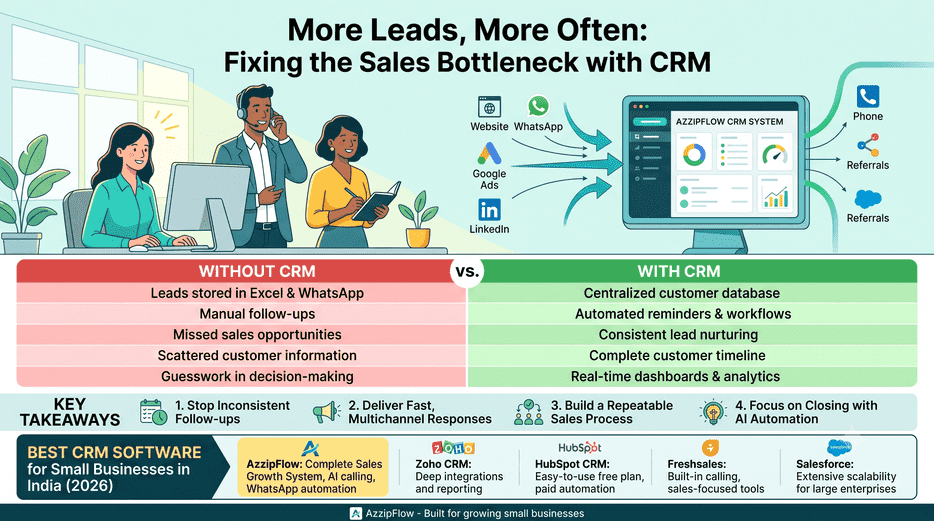
Leads can arrive from your website, Google Ads, Facebook, LinkedIn, WhatsApp, referrals, phone calls, or email campaigns.
In many businesses, someone still checks every source manually, copies customer details into a CRM, and decides who should follow up.
An AI Sales Growth Platform removes this bottleneck.
Every enquiry is automatically captured in one place and prioritized using signals such as customer engagement, enquiry source, previous interactions, and buying intent.
Instead of opening a long list of unqualified leads every morning, sales representatives immediately know which opportunities deserve attention first.
The result isn't more leads.
It's better decisions about the leads you already have.
B. Follow-up That Happens Automatically
Many sales opportunities are lost for one simple reason—no one followed up at the right time.
The best automation doesn't rely on someone remembering to create a task. It reacts to customer behaviour.
For example:
• A prospect downloads your brochure but doesn't respond within three days—the platform automatically sends a personalized follow-up email or alerts the sales representative.
• A quotation is opened but receives no response within 48 hours—a WhatsApp reminder is triggered automatically.
• A scheduled meeting is missed—the system immediately creates the next follow-up task.
Instead of relying on memory, your sales process continues moving even when your team is busy.
C. AI Calling That Creates Actionable Customer History
AI-assisted calling isn't valuable simply because it uses artificial intelligence.
Its real value lies in what happens after the conversation.
Every call can automatically record outcomes, customer objections, discussion summaries, and next actions, eliminating the need for manual note-taking.
When AI calling works alongside WhatsApp, email, and CRM in the same platform, every customer interaction becomes part of one continuous timeline.
Sales representatives no longer waste time searching across different applications before making the next call.
D. Analytics That Tell You What to Do Next
Traditional reports explain what happened yesterday.
Modern AI platforms help you decide what should happen today.
Instead of displaying numbers alone, they highlight opportunities that need immediate attention.
Questions an effective platform should answer include:
• Which marketing channel generates customers—not just enquiries?
• Which deals are most likely to close this week?
• Which sales representative needs support?
• Where are customers dropping out of the sales journey?
• What revenue is realistically expected this month?
The purpose of analytics isn't reporting.
It's better decision-making.
E. Automation That Eliminates Administrative Work
Every sales process contains repetitive tasks that consume valuable time without creating value. Examples include:
• Assigning leads to sales representatives
• Creating follow-up reminders
• Sending proposal notifications
• Starting customer onboarding
• Scheduling renewal reminders
• Updating sales stages
These activities don't require human judgment.
They require consistency.
An AI Sales Growth Platform handles these routine tasks automatically, allowing your sales team to focus on conversations, negotiations, and customer relationships rather than administration.
AI Sales Growth Platform Checklist
Before investing in any platform, verify that it can actually do the following—not just claim to.
✅ Capture leads from every marketing channel you use
✅ Prioritize leads using AI instead of simple timestamps
✅ Trigger WhatsApp, email, and follow-up actions based on customer behaviour
✅ Support AI-assisted calling with automatic call logging
✅ Provide real-time pipeline, sales, and revenue insights
✅ Automate repetitive administrative tasks
✅ Integrate with your existing business applications
✅ Scale easily as your business, team, and customer base grow
If your platform cannot deliver most of these capabilities, you're probably evaluating a traditional CRM with a few AI features added—not a complete AI Sales Growth Platform.
Let’s bring your ideas to life. Contact us today for a free consultation or book a demo with our team.
Why Businesses Are Moving from CRM to AI Sales Growth Platforms
CRM software solved an important business problem for many years. It gave companies a central place to store customer information, track opportunities, and manage sales pipelines.
For a long time, that was enough.
What has changed isn't the value of CRM—it's the way customers buy.
A single prospect might discover your business through Google Search, download a brochure from your website, ask a question on WhatsApp, engage with your LinkedIn content, and finally request a phone call. Every interaction happens on a different channel, often over several days or weeks.
A traditional CRM records these interactions once someone enters them.
An AI Sales Growth Platform connects them automatically and decides what should happen next.
If a lead stops responding, the platform can trigger a follow-up.
If a prospect opens a proposal but doesn't reply, the system can notify the sales representative.
If a high-value lead arrives through Google Ads, it can be prioritized immediately without waiting for manual assignment.
The shift isn't about replacing CRM.
It's about extending CRM into a platform that actively helps businesses move opportunities forward instead of simply recording what has already happened.
As customer journeys become more complex, businesses need systems that don't just collect information—they help teams respond faster, make better decisions, and keep every opportunity moving.
Where AzzipFlow Fits
Most CRM platforms are designed to manage customer information.
Growing businesses usually discover that managing customer information is only one part of running an effective sales process.
They still need separate software for AI calling, WhatsApp communication, email campaigns, reporting, sales analytics, and performance tracking. Each additional tool creates another place where information can become disconnected.
AzzipFlow was designed to solve this problem differently.
Instead of adding more software to the sales process, it brings the essential parts of sales growth into one connected platform.
Here's what that looks like in practice.
A lead arrives through your website or a marketing campaign.
The platform captures the enquiry automatically, assigns it to the appropriate sales representative, evaluates its priority using AI, and initiates the appropriate communication workflow.
If the prospect doesn't respond, follow-up actions continue automatically through predefined workflows.
Every conversation, activity, and sales update is recorded within the same customer timeline, giving the entire team complete visibility without switching between multiple applications.
Because CRM, AI Calling, WhatsApp Automation, Email Automation, Lead Management, KPI Tracking, and Business Analytics all operate from the same data, business owners always have a clear picture of where every opportunity stands.
The benefit isn't simply having fewer software subscriptions.
It's having one connected sales process where information moves automatically instead of employees moving it manually.
As businesses grow, that difference becomes increasingly valuable.
Future Opportunity:
This section becomes even stronger if you add a real customer success story, measurable improvement (such as reduced follow-up time or increased conversion rate), or implementation outcome from an AzzipFlow customer. Real examples significantly strengthen EEAT.
How to Choose the Right AI Sales Growth Platform
By now, you've seen the features an AI Sales Growth Platform should offer.
Before making a decision, step back and evaluate the platform from a business perspective rather than simply comparing feature lists.
Ask yourself:
Does it solve your biggest sales bottleneck today?
If your biggest challenge is delayed follow-ups, automation matters more than advanced reporting.
If reporting is your problem, focus on analytics instead of additional communication tools.
Choose the platform that solves your current business challenge first.
Will your team actually use it?
Even the most advanced platform creates no value if employees find it difficult to adopt.
Look for intuitive workflows, minimal training requirements, and an implementation process that helps your team become productive quickly.
Can it grow with your business?
Your sales process will evolve.
The platform you choose today should support additional users, larger lead volumes, new automation workflows, and changing business requirements without forcing another migration a year later.
Does everything work together?
Many platforms advertise similar features.
The real difference lies in how well those features are connected.
Ask whether CRM, communication, automation, analytics, and AI operate from the same customer data—or whether they still require manual updates between different systems.
That's often the difference between software that stores information and software that actively helps your business grow.
Conclusion
Businesses rarely struggle because they lack software.
More often, they struggle because the software they use doesn't work together.
When customer information is scattered across multiple applications, sales teams spend valuable time updating records, switching between tools, and manually coordinating follow-ups instead of building customer relationships.
An AI Sales Growth Platform addresses this challenge by bringing lead management, communication, automation, AI, and analytics into one connected workflow.
The objective isn't simply to make sales teams more efficient.
It's to help businesses respond faster, make better decisions, and convert more of the opportunities they already generate.
If you're evaluating your first CRM—or replacing multiple disconnected sales tools—don't focus only on features.
Focus on how much manual work the platform removes and how effectively it helps your team move every customer from enquiry to conversion.