.png&w=3840&q=75)
The Problem: Scattered Learning Materials Are Silently Failing Your Students
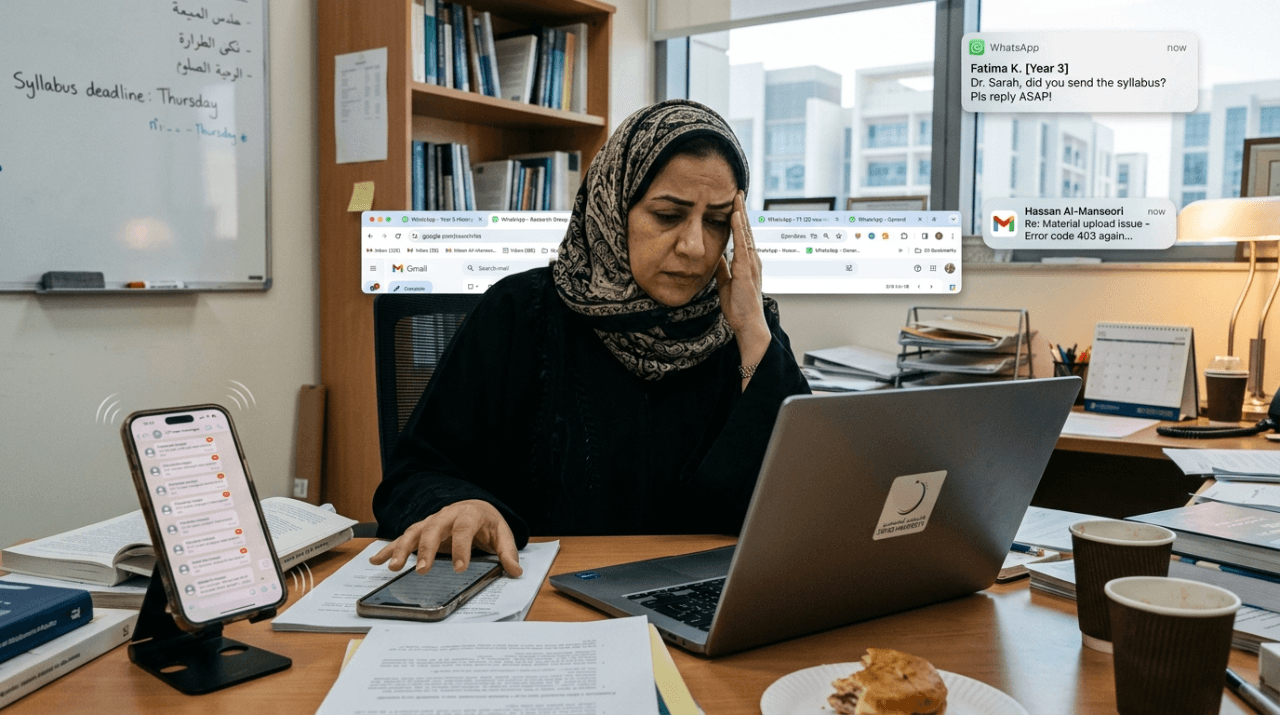
Every semester, across hundreds of UAE colleges, universities, and training institutes, a familiar scene plays out. A faculty member wraps up a lecture and immediately faces a flood of WhatsApp messages — 'Sir, can you resend the PDF?' 'Ma'am, I didn't get the assignment file.' 'Which version of the notes should we study?' The teacher re-sends. Again. And again. One faculty member at a Dubai college put it plainly: 'I spend more time re-sending PDFs than actually teaching.' That single sentence says everything. When a teacher's biggest daily task is managing a file delivery system that was never designed for education — that isn't a communication problem. It's a system failure. Faculty sharing learning materials through WhatsApp and email is one of the most common — and most overlooked — operational failures in UAE education today. Notes, PDFs, videos, recorded sessions, and assignment briefs are scattered across personal WhatsApp groups, email threads, Google Drive links, and USB drives handed around in corridors. There is no single source of truth. No organized structure. No guarantee that every student has the same version of the same file. According to the KHDA's Digital Learning Strategy for Dubai (https://www.khda.gov.ae), UAE educational institutions are expected to adopt structured digital content delivery systems as part of their quality assurance and accreditation frameworks — yet informal channels like WhatsApp remain dominant in day-to-day content sharing. With the UAE's edtech market valued at over AED 2.5 billion and growing at a CAGR of 11.83%, institutions can no longer afford to let content delivery remain this fragmented. The solution isn't more WhatsApp groups. It's a purpose-built LMS.
Why This Problem Is Bigger Than It Looks
At first glance, sending a PDF over WhatsApp seems harmless. But zoom out across an entire faculty, an entire semester, an entire institution — and the true cost becomes clear. The real damage isn't in the re-sending. It's in what the re-sending signals to students about how seriously your institution takes their learning experience. A teacher managing three batches of 60 students each is simultaneously juggling three WhatsApp groups, three email threads, and no searchable archive. When a student asks for the Week 4 notes, the teacher re-sends, guesses, or says 'check the group.' Multiply this across 40 faculty members — and the institution is operating on daily chaos. When a teacher updates a lecture slide, the old version continues to live in students' inboxes and chat histories. Students submit work based on the wrong brief. Confusion escalates into complaints. And when a substitute teacher steps in mid-semester, they have zero visibility into what was shared or covered before them. Every new hire starts from zero. 'If your content lives in WhatsApp, your institution is operating without a system.' — And in 2026, that is no longer acceptable.
The Confusion Multiplies Fast A teacher managing three batches of 60 students each juggles three WhatsApp groups, three email threads, and no searchable archive of what was sent when. When a student asks for the Week 4 notes, the teacher re-sends, guesses, or says 'check the group' — none of which are reliable. Multiply this across 40 faculty members and the institution is operating on daily chaos with no systemic fix in sight.
Version Control Is Nonexistent When a teacher revises an assignment brief or updates a lecture slide, the old version keeps living in students' inboxes, download folders, and chat histories. Students submit work based on the wrong brief. Confusion escalates into complaints, and complaints escalate into academic disputes. There is no version control in email. There is no version control in WhatsApp. Only an LMS for sharing study materials manages this cleanly — uploading a new file automatically replaces the old one across all enrolled students' views.
New Faculty Have No Access to Course History When a substitute teacher steps in or a new faculty member joins mid-semester, they have no visibility into what materials were already shared, what was covered, or what comes next. Every new hire starts from zero. An LMS preserves the complete course history — accessible to any authorized faculty member from day one, without any manual handover or file-hunting required.
Student Outcomes Suffer Quietly When students can't reliably access materials, they disengage, fall behind, and stop trying. In the UAE's competitive higher education landscape — where student satisfaction scores directly influence KHDA ratings, accreditation renewals, and institutional reputation — this matters far more than most administrators realize. The content delivery problem is ultimately a student outcome problem.
.png&w=3840&q=75)
The Real Cost: What UAE Institutes Are Losing Every Semester
The inefficiency of WhatsApp and email-based content distribution isn't just an inconvenience — it carries a measurable institutional cost. A mid-sized Dubai institute with 50 faculty members spending just 3 hours per week on content redistribution loses 2,400 hours per semester. That's 60 full working weeks of faculty productivity vanished into WhatsApp groups and email threads every single academic year — and this doesn't include the student hours lost, or the downstream academic impact of missed or wrong-version materials. Those 2,400 hours represent time that could have been redirected to lesson design, student mentoring, research, and institutional development — activities that actually move the needle on accreditation and student outcomes. Is your institution silently paying this cost right now? So if WhatsApp and email so clearly fail at this job — why are UAE institutions still relying on them in 2026? The answer is simpler than you think: no one has officially replaced them with something better. The problem isn't ignorance — it's inertia. And an LMS breaks that inertia permanently.
The Solution: LMS as the Single Source of Truth for Learning Content
An LMS transforms how teachers share content digitally — replacing fragmented channels with one structured, always-accessible platform. Every course has its own dedicated space. Faculty upload notes, PDFs, PowerPoint decks, video recordings, external links, and assignment briefs — organized by week, topic, or module. Students access everything through a single login. No links to chase. No groups to join. No files to hunt for. When a faculty member uploads an updated file, it replaces the previous version automatically. All students see the latest content immediately and without any manual redistribution. Modern LMS platforms support every format faculty use: PDFs, Word documents, PowerPoints, MP4 videos, YouTube embeds, scanned images, audio recordings, and assignment briefs with deadlines attached. Students no longer jump between email, WhatsApp, YouTube, and Google Drive — everything lives in one place. According to a UNESCO Digital Education report (https://www.unesco.org/en/digital-education), over 65% of learners globally now prefer mobile-first access to study materials — a trend UAE institutions can only fully serve through a structured LMS, not a WhatsApp group. A teacher's job is to teach — not to manage a file delivery system. The moment your institution understands this difference, the LMS decision makes itself.
Batch-Specific Access Control A faculty member teaching Year 1 and Year 2 students uploads materials to separate course spaces — with each cohort seeing only what is meant for them. No accidental cross-batch sharing. No wrong-group messages. No content leaks. This is structurally impossible to manage reliably with WhatsApp groups. It is the default in any properly configured LMS.
Automated Notifications When a teacher uploads new material, enrolled students receive an automatic notification via the LMS app, email, or SMS — depending on the institution's settings. Faculty no longer need to separately announce uploads on WhatsApp. The system handles it. One upload triggers the entire communication chain automatically.
Mobile Access — Anytime, Anywhere Leading LMS platforms in the UAE offer fully functional mobile apps with offline download capability. Students in areas with limited connectivity can download materials in advance and access them without internet. This directly supports the UAE's mobile-first learner profile and aligns with KHDA's expectations for accessible, flexible digital content delivery.
Complete Course History and Faculty Handover An LMS preserves every uploaded material, module, and communication in a searchable, permanent archive. When a new faculty member joins or a substitute covers a class, they see the full course history instantly — what was taught, what was shared, and what comes next. No handover meeting. No manual file transfers. No starting from scratch.
Real-World Impact: How UAE Institutes Are Seeing Results
A private university in Sharjah managing 1,800 students across four faculties was operating on a patchwork of WhatsApp groups, personal email lists, and shared Google Drive folders — with no consistency between departments. After deploying a centralized LMS and mandating all course content be uploaded before semester start, the institution saw a 68% reduction in student content-related queries within the first semester. Faculty reported saving an average of 4 hours per week previously spent re-sending files and managing batch groups. Assignment quality also measurably improved — directly attributed to students finally having reliable, version-controlled access to the correct brief. A vocational training institute in Abu Dhabi was onboarding 300 new students every quarter, requiring the same foundational materials each time. By uploading all content to the LMS once and linking each new cohort to the same library, the institute eliminated batch-specific redistribution entirely. New cohort onboarding time dropped from 3 days to under 4 hours.
How UAE Administrators Can Drive This Change in One Semester
Knowing the solution is one thing. Getting 40 faculty members to change their habits is another. The rollout starts with a 2-week audit to identify which departments use which channels and where the biggest friction points are. Week 3 focuses on selecting and configuring an LMS with bilingual support, mobile offline capability, and KHDA/MOE-aligned reporting. Week 4 is about pre-loading content — assigning a support resource to help faculty upload existing materials before go-live. Week 5 runs a mandatory 90-minute hands-on training session where every faculty member uploads three real files from their own course. Week 6 onward enforces the standard: the LMS is the only official channel for course materials. When students stop asking on WhatsApp because they know content is on the LMS, faculty habits follow within days. And here's the part that surprises most administrators — once faculty experience a semester without the content chaos, very few want to go back. The resistance is always front-loaded.
Week 1–2: Audit and Map Current Channels Identify which departments are using which channels for content sharing. Most complaints will cluster around a few high-volume courses or faculties. This audit gives you the data to prioritize rollout and build an internal business case for switching to a centralized LMS.
Week 3: Select and Configure the LMS Choose a platform with bilingual (Arabic/English) RTL support, mobile offline capability, and integration with your student information system. UAE-specific platforms aligned with KHDA and MOE reporting frameworks will reduce compliance overhead significantly and eliminate manual audit preparation.
Week 4: Pre-Load Existing Content Assign a dedicated support resource to help faculty upload existing materials to the LMS before going live. Reducing the 'blank page' problem is the single biggest accelerator of faculty adoption — once their existing content is already there, the barrier to continued use almost disappears.
Week 5 Onwards: Enforce the Standard and Measure Communicate clearly to faculty and students: the LMS is the only official channel for course materials. At semester end, pull data on support ticket reductions, faculty time savings, and student engagement metrics. Share results publicly within the institution — real numbers from colleagues drive adoption faster than any training session or mandate.
Let’s bring your ideas to life. Contact us today for a free consultation or book a demo with our team.
.png&w=3840&q=75)
Why AzzipTech's LMS Is Built for UAE Faculty Needs
AzzipTech's LMS platform is designed specifically for UAE and GCC educational institutions — not a generic global product adapted as an afterthought. Every capability is built around the real operational context of UAE faculty: bilingual content, compliance frameworks, mobile-first students, and multi-batch course delivery. Trusted by institutions across Dubai, Abu Dhabi, and Sharjah, AzzipTech's LMS replaces the fragmented patchwork of WhatsApp, email, and Drive with a single structured platform that faculty learn in one session and students rely on every day.
Key Capabilities Built for UAE Faculty
AzzipTech's LMS gives faculty everything they need to organize, deliver, and manage learning materials without relying on informal channels. The platform supports all content formats — PDFs, videos, SCORM packages, live session recordings, and external links — in one unified course view. Automated student notifications fire when new materials are uploaded, eliminating the need for WhatsApp announcements. Granular batch and cohort management ensures each student group sees exactly the right content, with no cross-batch errors. The mobile app with offline access aligns with the UAE's mobile-first learner profile. KHDA and MOE-aligned reporting generates content access logs and usage analytics ready for institutional audits. For medical and vocational institutes, an integrated eLogbook (https://azziptech.com/elogbook) combines course content delivery with competency tracking in a single platform.
Bilingual RTL Interface AzzipTech's LMS offers full Arabic (right-to-left) and English support at both interface and content levels. Faculty upload Arabic-language materials, build RTL course modules, and communicate with students in both languages natively — without switching platforms. Essential for UAE institutions serving mixed Arabic and English-speaking student populations under KHDA and MOE compliance standards.
KHDA and MOE-Aligned Reporting Content access logs, usage analytics, and faculty activity reports are generated automatically — ready for KHDA audits, MOE compliance reviews, and accreditation submissions. Institutions no longer need to manually compile content delivery evidence. The LMS produces it in real time, on demand, without any additional administrative effort.
Integrated eLogbook for Medical and Vocational Institutes For healthcare and vocational training institutions, AzzipTech's LMS includes a fully integrated eLogbook for clinical and residency programs. Faculty manage course content delivery and competency tracking in a single platform — eliminating the need for a separate logbook system and reducing administrative overhead for both educators and accreditation bodies.
Proven Deployment Across UAE Institutions AzzipTech's LMS is trusted by universities, vocational institutes, and corporate training centres across Dubai, Abu Dhabi, and Sharjah. Institutions report measurable outcomes within the first semester of deployment — including significant reductions in content-related student queries, faculty time savings of 4+ hours per week, and improved assignment quality from students accessing correct, version-controlled materials.
.png&w=3840&q=75)

.png&w=3840&q=75)
.png&w=3840&q=75)
.png&w=3840&q=75)